

Nitrogen Generators: What is a N2 Nitrogen Generation System?
Across many industrial, manufacturing, food, and research applications, a nitrogen generation system is a backbone utility: it delivers a continuous supply of nitrogen gas exactly on-site, on-demand. Whether you’re preserving freshness in packaging, maintaining inert atmospheres for welding or brazing, or ensuring safety in oxygen-sensitive processes, using an in-house nitrogen generator can offer reliability and cost savings that bottled or delivered gas often cannot match.
In this article, we’ll explain what a nitrogen generator is, explore how nitrogen generation systems work, and show you the main types and benefits of installing one.
What Is a Nitrogen Generator System?
A nitrogen generation system (also called a nitrogen generator) is a setup that extracts nitrogen gas from the ambient air, purifies it to a required purity level, and delivers it for use in-house. Instead of ordering nitrogen in cylinders or bulk deliveries, the system makes nitrogen continuously at your facility, customized to your usage rate and purity needs.
Key components of a nitrogen generator typically include a source of compressed air, filters and dryers to remove moisture, particulates, and oil, the separation module where nitrogen is isolated, and controls, safety features, and sometimes storage or buffer tanks.
How Does a Nitrogen Gas Generator Work?
There are multiple technologies for separation, and each nitrogen gas generation system might use one or more different methods depending on required purity, flow rate, pressure, and cost. Two of the most common technologies are PSA (Pressure Swing Adsorption) and membrane separation.
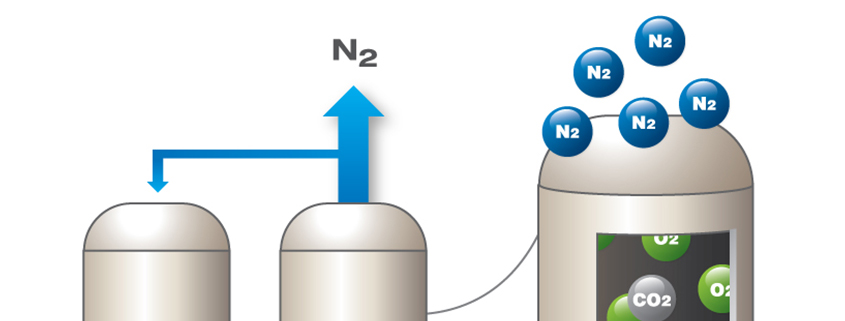
PSA systems pass compressed air through vessels filled with an adsorbent like carbon molecular sieve. Oxygen, along with CO₂ and water vapor, is adsorbed under high pressure while nitrogen passes through. The pressure is then released so the adsorbent regenerates, and the cycle alternates between two or more vessels to provide continuous output. PSA can deliver very high purity levels, often exceeding 99%.
Membrane systems push compressed air through a membrane that allows oxygen and water vapor to pass through faster than nitrogen. The slower nitrogen flow is collected as product gas. While membrane systems typically achieve 95–99% purity, this is often sufficient for many industrial applications.
Here is a step-by-step summary of how a typical PSA nitrogen generation system works:
- Air intake & compression – Ambient air is drawn in and compressed to a target pressure.
- Pre-treatment – Filtration, drying, and cooling remove moisture, oil, dust, and CO₂.
- Adsorption – Cleaned, compressed air enters a vessel filled with carbon molecular sieve. Oxygen and other unwanted components are captured while nitrogen passes through as the product.
- Switching / Desorption – Once the adsorbent becomes saturated with oxygen, the system directs air to another vessel while the saturated vessel regenerates by reducing pressure, releasing the oxygen.
- Purity control & buffering – Sensors monitor nitrogen purity, and buffer tanks or storage smooth out fluctuations in demand.
- Delivery – Purified nitrogen is delivered to the point of use or stored if needed.
Types of Nitrogen Generation Systems
Different configurations suit different needs. Options include turnkey PSA generator systems, membrane nitrogen generators for lower-purity applications, custom engineered systems for unique requirements, containerized or modular systems for portable operations, and cylinder-filling systems for facilities that want to fill their own nitrogen cylinders.
Industries that Use Nitrogen Generator Systems
Nitrogen generator systems are used across a wide range of industries that rely on inert gas environments to improve safety, quality, and efficiency. Key sectors include food and beverage, pharmaceuticals, electronics, oil and gas, aerospace, and general manufacturing—all of which depend on nitrogen to prevent oxidation, contamination, or combustion risks. For example, food producers use nitrogen to preserve freshness, while electronics manufacturers rely on high-purity nitrogen during soldering and assembly processes. Oil and gas companies use nitrogen for tank blanketing and pipeline purging, and pharmaceutical manufacturers depend on it to maintain product stability.
Common industries that rely on nitrogen generation systems include:
- Food & Beverage (packaging and preservation)
- Pharmaceuticals (product stability and contamination prevention)
- Electronics Manufacturing (soldering and assembly processes)
- Oil & Gas (purging, blanketing, and pressure testing)
- Aerospace (component testing and inert environments)
- General Manufacturing (process optimization and safety)
Because nitrogen is non-reactive and readily available through on-site systems, it has become an essential utility where precision, safety, and product integrity are critical.
Common Applications for Nitrogen Generators
Nitrogen generators support a variety of applications centered around controlling oxygen levels and creating stable, inert environments. One of the most common uses is modified atmosphere packaging (MAP), where nitrogen replaces oxygen to extend shelf life and maintain product quality. In industrial settings, nitrogen is widely used for purging, blanketing, pressure testing, and leak detection—helping to prevent corrosion and reduce fire or explosion risks.
Typical nitrogen generator applications include:
- Modified Atmosphere Packaging (MAP) for food preservation
- Tank blanketing to prevent oxidation and contamination
- Pipeline purging and pressure testing
- Leak detection in industrial systems
- Laser cutting for cleaner, more precise cuts
- Tire inflation for improved pressure stability
- Electronics manufacturing to prevent oxidation during soldering
Whether used for preservation, safety, or performance, nitrogen generators provide a reliable, on-demand gas supply that supports consistent operations across countless applications.
Tips for Specing Your Nitrogen Generator System
When specifying a nitrogen generator system, it’s critical to evaluate your required nitrogen purity, flow rate, and pressure, as these factors directly impact system design and cost. Higher purity levels (such as 99.9%+) typically require PSA technology, while lower purity needs may be met with membrane systems at a lower cost. You should also consider peak demand vs. continuous usage, as well as whether storage tanks are needed to buffer supply.
Key factors to consider when specing your system:
- Required nitrogen purity level (e.g., 95% vs. 99.999%)
- Flow rate (SCFM) based on operational demand
- Delivery pressure requirements
- Peak vs. continuous usage needs
- PSA vs. membrane technology selection
- Need for storage tanks or backup systems
- Energy efficiency and operating costs
- Future scalability and system expansion
Factoring in these elements upfront will help ensure long-term ROI, efficiency, and reliability. Working with an experienced provider ensures your nitrogen generation system is properly sized and aligned with your exact operational needs from day one.
Why Choose a Nitrogen Generation System?
Key benefits include cost savings compared to bottled or bulk nitrogen, supply reliability with independence from delivery schedules, the ability to set and maintain exact purity levels, and operational flexibility to match changing demand. Additional advantages include fewer safety and handling risks and a reduced environmental footprint thanks to less transportation and packaging waste.
Contact On Site Gas Systems For Your Nitrogen Gas Needs!
Ready to bring the benefits of an on-site nitrogen generator system to your operation? Contact On Site Gas Systems today to discuss your specific N₂ generator needs. Our team will help you evaluate your nitrogen requirements, recommend the right system for your application, and guide you through every step—from design and installation to ongoing support—so you can enjoy a reliable, cost-effective supply of high-purity nitrogen on demand.






Leave a Reply
Want to join the discussion?Feel free to contribute!